Compost Your Suffering
Dread
Last night when I took the kitchen scraps out to our compost pile I was hit with a sense of urgent dread. I know, probably a bit dramatic but it's always those small moments in life where those unattended feelings seem to crack through my best attempts to keep them at bay. Urgency for my attention to cleaning out the chicken coop, turning the compost, and preparing the garden beds for the growing season. These are all things I have willfully chosen, genuinely love, and see as part of my mindfulness practice. But they also require energy and time, both finite resources in my limited human capacity.
When we first moved into this house a little over 6 years ago I knew I wanted to turn a significant part of the back yard into a garden, and we have. I’ve also always wanted chickens and this home has allowed us the space to do that too. One of the reasons I keep chickens is because their manure is one of the greatest fertilizers we can get, not to mention organic and free(ish, let’s not talk about the cost of feed). The eggs and their company are nice bonuses. In fact their manure is such a great fertilizer it can actually be too rich and if applied directly to plants has the risk of hurting plant roots. This is why it's best to first incorporate the manure into a compost pile, let it heat up, and then spread it onto the garden beds. For 90% of the year the compost pile looks like the picture below, nasty garden scraps slowly rotting away and feeding the city rats (squirrels). But about twice a year I go through the hard work of clearing out the chicken coop and run, turning the compost pile, and layering in the manure like a Michelin star chef making a beautiful layered cake.
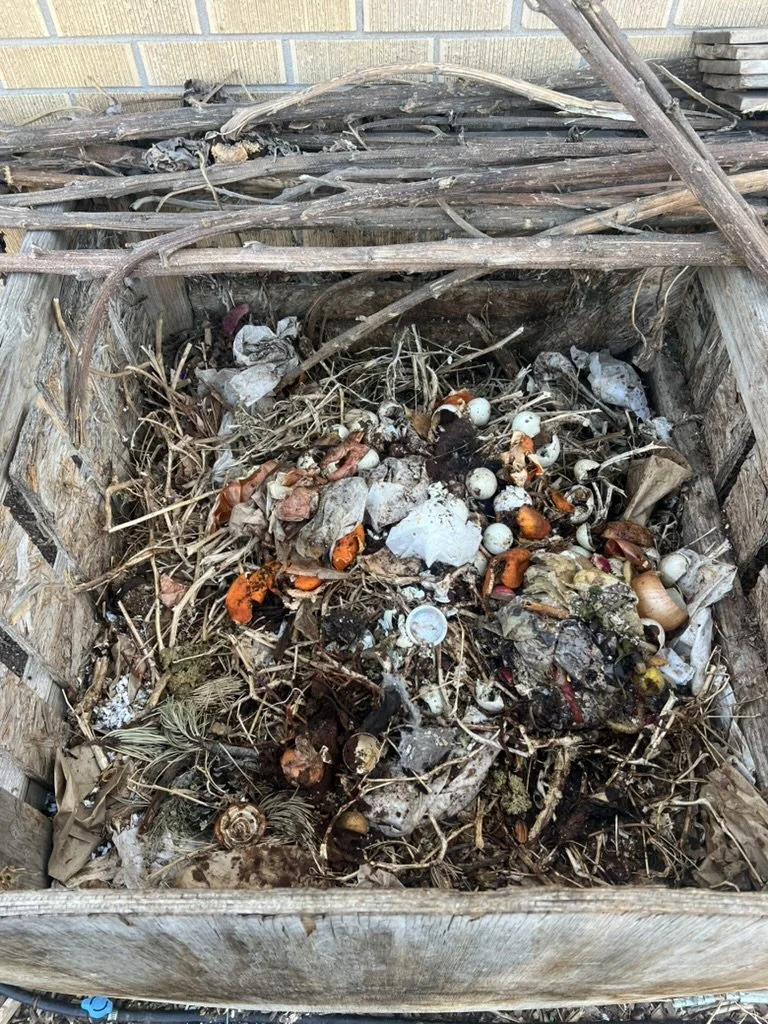
The compost pile this morning
Dirt under my fingers
I've never shied away from hard manual labor. One of the first jobs I had growing up was working on a farm laying literally miles of irrigation pipe by hand. The first job I had when I moved to Colorado was a crew leader for a landscaping company. Deep rooted within myself is a the value if I can do it myself, I will. Sure there is stubbornness within this and my limited means as part of the socioeconomic class I exist in within this imperialist system means I rarely have the money to hire help but my true self thrives when I have dirt under my nails, aching muscles, and a strong dose of vitamin D.
When I set my mind to it, I genuinely love the practice of clearing out the chicken shit, mixing it into the last 6 months of kitchen scraps, and within a few days watching the compost thermometer shoot up well above 100 degrees (my personal record is over 150). It also gives off a profound earthy, slightly foul smell that I love. After about 2 weeks or so the compost begins to cool and it's ready to go out on to the garden. I've intentionally chosen this life style as a means of cultivating provisions for myself and my family, modeling to my daughter (and my own inner-child) what it means to be a steward of the land, and it's what's in my control to nourish our planet's vital top soil. Slight tangent for a moment, if you didn't know we've lost roughly half of the earth's top soil since the industrial revolution and some estimates show we are losing the equivalent of FOUR football fields of soil EVERY SECOND. Sure my efforts are a single drop in the ocean but damn it, it's what I can do.
All change is loss
I share this part of my life with you not because I am trying to convince you to also stick your hands in the soil, though I would love for you to do that too, but because I find rich metaphor within every part of the gardening practice and amongst our wild flower friends. Change is hard. Damn it, it feels like there's never enough volume in written text. CHANGE FUCKING SUCKS. Pardon my french. My spiritual director introduced me to a phrase some time ago - all change is loss and all loss needs to be grieved. I use to think grief was a stage quickly moved through with a few shed tears. Composting is helping me learn that attending to grief is the way, not a fixed destination we "get through". There's the piling on of all the waste and leftovers that need to be let go of, accumulating, accumulating, accumulating. We find some rich nutrients to mix in hoping to speed up the process but in reality that's just the start. Compost literally turns rotting waste into black gold but we can't exactly eat that black gold, it's just the foundation. But that foundation is perhaps the most important part of our growth. We have to learn to feed the soil of our souls.
When the compost pile heats up to those high temperatures two vital processes happen. First it kills a lot of the dormant seeds from invasive plants like thistle or the gazillion tomato seeds from all of last year's left behind. Second, it breaks down the quick releasing forms of nutrients into slower releasing forms that are more stable for the plants. Both of these functions are achieved by the billions of microbes living in the soil. When I pause to really think about just how profound the cycle of life is it's quite awe inspiring.
My approach to gardening is I feed the soil, not the plants, that's not my job, that's the job of my microbial Sangha.
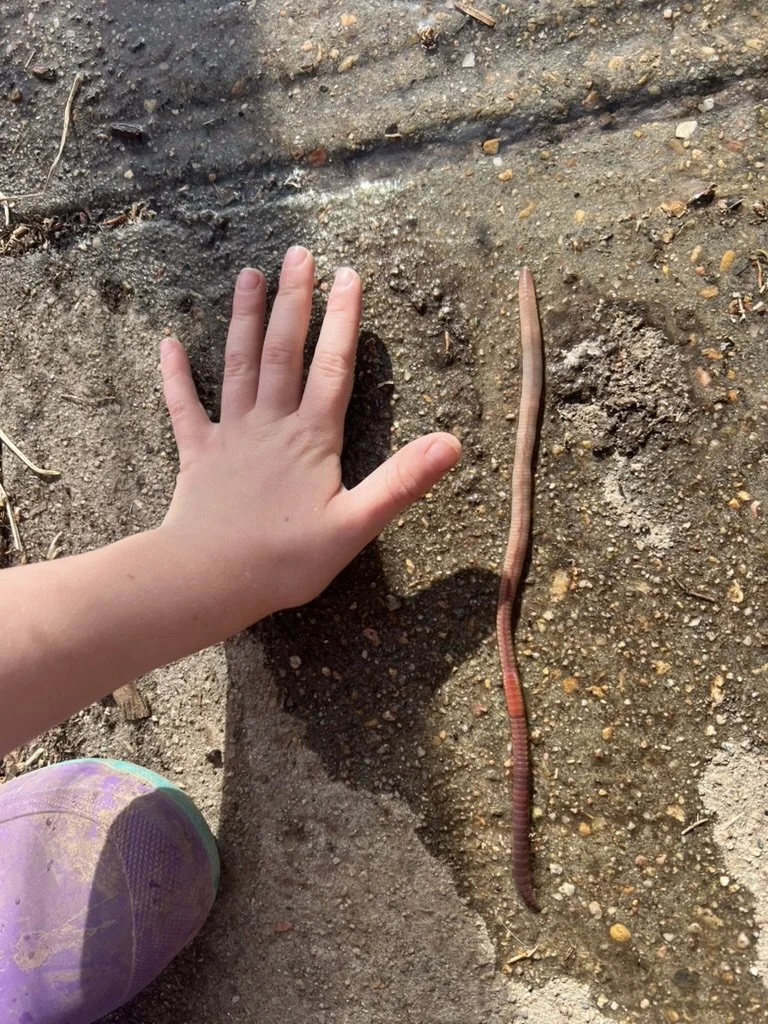
The most giant earth worm we’ve seen referenced next to my daughter’s hand 2/7/26.
The blooms will come
There are no short cuts to our healing and growing process. There's no avoiding suffering in life. Suffering is part of our human condition. Zen master Thich Nhat Hanh talked a lot about composting our suffering, transforming the shit (my words, not his) of life into rich nutrients for the fruit, flowers, and beauty we hope to one day enjoy. In my work as a therapist I find that if we are really being honest we all want quick fixes, short cuts, a magic wand, or an answer to how to "get through" something in life. Maybe the path is in learning to compost. Maybe we need to let go of those years old left overs that no longer serve the person you are, feed it to the compost, mix some shit in, and trust that you are on the right path. Composting is not an exact recipe but I know that if I follow a few simple yet profound steps, connect with my body and breath in meditation, what flourishes will be unlike anything I can imagine.
So take this as your cue, go stick your hands in the soil, turn the compost, breathe in that wonderful earth. Yes you’ll have to do it all over again, and again, and again, but get ready those columbine blooms are about to open.
A columbine bud in our garden about to open 4/10/26
If any of this resonates with you and you’d like a place to process what needs composting in your life, reach out.
I’d be honored to journey with.